 English
 Português
 Español
With our CoW solution, the essential quest has been to make hazardous industries safer with better digital permit management from first principles. UX innovation and AI are our tools. UX is an often-overlooked area in industrial software. AI even more so. The mainstream in AI is curiously focused on amusing, privileged people that are already amusing themselves to death.
We think there’s a better way.
Beginning with digital permits.
Figure 1: Command centre – central graphical map
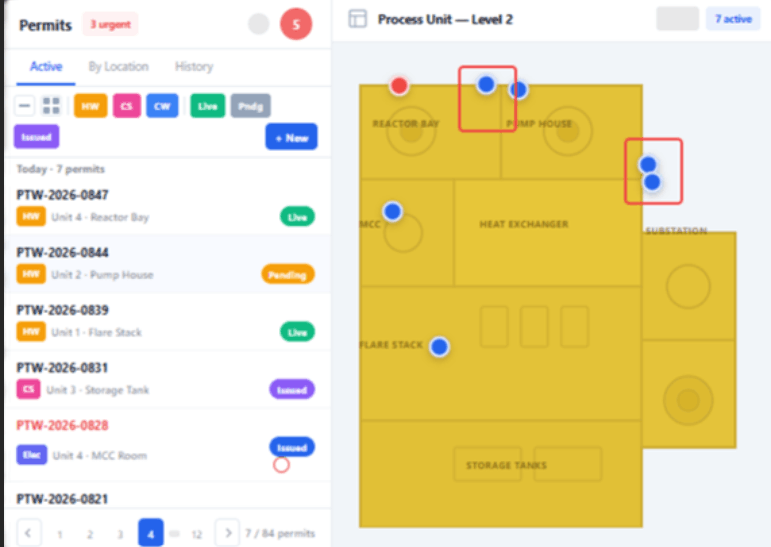
Digital permits have been around for decades. Digital permits form the core of control-of-work. The industrial software ecosystem has concluded that digital permits have been solved and innovation in the control-of-work will now come from SIMOPs. We disagree. There’s still a lot of value to be had just from getting the basics right.
(We do have solid SIMOPS – refer to Figure 1)
Our belief system stems from the fact Maximl builds software for the user, not the buyer. This is, sadly, a radical idea in heavy industry.
Safety in hazardous industries will improve when compliance is convenient, and no trade off needs to be made on what’s expedient and what’s safe. Industrial safety is not a question of figuring out the right processes and controls. That is known. What’s missing is total adherence to process.
There is no dearth of HSE best practices. The best practices are codified into bodies of knowledge maintained by industry groups, jurisdictions, and individual companies. The task for any HSE function is to remove any friction on the path of SoP compliance.
The friction begins with buying software that might check all the boxes on a RFI form but doesn’t meet the needs of a single real field user. Anything slightly unfamiliar or inconvenient to the industrial field worker, and a regression to paper happens – with all the attendant troubles.
We struggled with this for some time before being hit with an epiphany. While at a permit review meeting inside an offshore office of an upstream operator, we realized the de facto process of issuance and approvals involved personnel in a room passing stapled paper permits around. A quick look at the job type and job description and easy collaboration was at the heart of safety.
Figure 2: The Maximl permit – paper-like UX
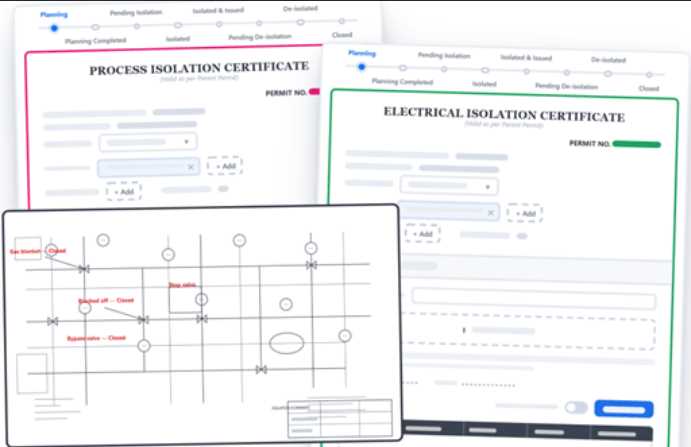
Prior to the epiphany, we had a tabbed interface – like every other enterprise software company. Afterwards, we decided to simplify. There are no tabs now. Instead, our interface now looks like paper with all the essential information in a single page. The stapled certifications have been replaced by similar ‘pages’ on a sidebar.
The page offers quick visual clues on the nature of the job the permit is about in the form of icons (confined space, excavation, work at height) and colours (especially border colours – red for hot work, yellow for cold work, orange for spark potential, violet for radiography etc.). The goal is to allow field workers whose first language might not be the language of the permit to grasp the important parts.
(refer to Figure 2)
Making the interface a breeze is a critical step towards improving compliance. A good UX keeps the users on the designated tool and prevents regression to paper. But there’s more.
Figure 3: Contextual safety interlocks
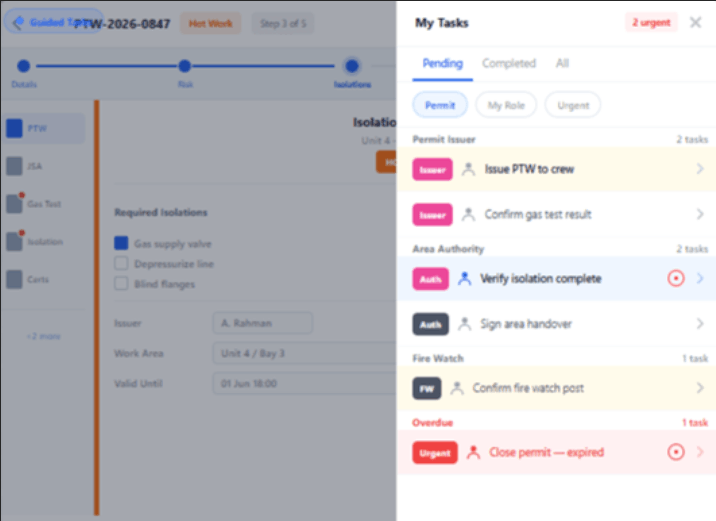
Our ‘contextual safety interlocks’ mechanism, made accessible through the Task Pad, enforces the SoP. Before the prerequisites of a task are executed, a permit cannot be issued for said task. The option is ‘greyed out’ on the task pad interface. The contextual interlock mechanism maintains a real time record of the status of all permits, and the interlocks are informed by such information. To illustrate – certain tasks cannot be executed until an isolation is live.
(Refer to Figure 3)
Maximl’s Task Pad makes compliance with the SOP straightforward. The system can accommodate multiple SoPs prescribed by, and originating from, different bodies of knowledge. This offers an easier way to build an enterprise-wide platform for organizations with many sites that have to comply with safety regulations across more than a handful of jurisdictions.
It has also been our experience that with the Task Pad enforcing the SoP, onboarding becomes a lot easier. We have reduced onboarding time to 90 minutes.
Figure 4: mobile interface – PIN-based authentication
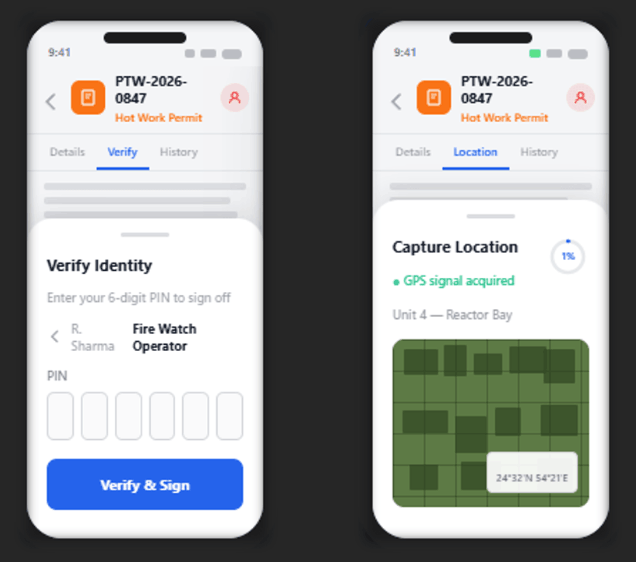
With careful design, compliance can be improved and every chance of regression to paper eliminated. Mobile access is a source of friction. In certain situations, the number of field workers could increase, such as during a turnaround (i.e. STO or planned shutdown). Scaling mobile devices is expensive. We have built a PIN-based authentication system, enabling workers in a crew to share a device, with everybody having a unique PIN (refer to Figure 4).
Of course, an issue with mobility is that not all sites are within the range of reliable cellular networks. We have therefore built the mobile solution to be offline first, to sync with the server when connectivity is restored.
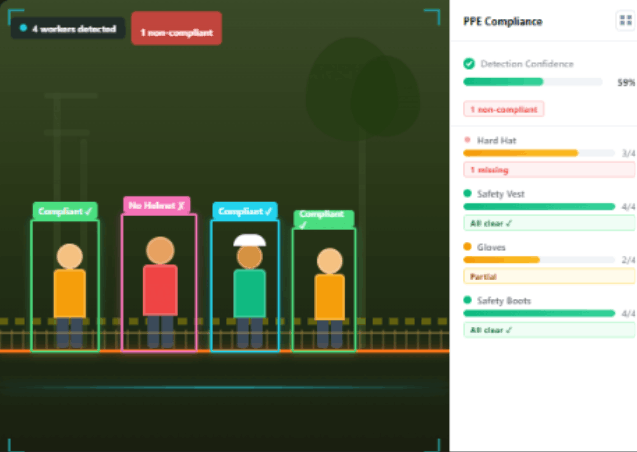
Maximl believes while the first step is fixing every gap such that nobody misses paper, the second critical step is to enable things impossible with paper – such as proof of work. We have built in steps (can be mandatory or optional) for submitting images and videos. This required much image processing optimization because in our industry the bandwidth constraints are often extreme. But the principle underlying everything we do is the same – build for the user, which requires attention to the minutiae.
Mobility improves compliance using geolocation, ensuring that tasks mandated to be performed onsite are actually executed onsite.
(refer to Figure 5)
Figure 5: Image processing-based validation
In the Maximl portfolio of technologies a major application of AI has been the extraction of information from p&IDs, pfds, and other technical diagrams, using a mix of computer vision (CV) and natural language processing (NLP) algorithms. The information thus extracted helps build a map of the site’s assets, establishing interrelationships in material flow, energy flow, spatial, and logical terms. This map helps recommend missed isolation points.
On the same note of using AI to make specific things better, a Maximl tool can generate Toolbox Talk content – using the existing corpora of text on permits. This is particularly useful when there’s a need for translation. The permit owner is often not somebody who speaks English as the first language. The crew, at least as often, isn’t either. With Gen AI making machine translation economical, the key task is to generate the appropriate source content in English. The goal of generating such content is to ensure that toolbox talk doesn’t become a mere checkbox but actually serves its purpose – which is to brief the crew on what the job entails. On the same note, our platform can rate a toolbox talk briefing, using voice-to-text for transcription and NLP after.
Figure 6: RAG-based safety recommendations
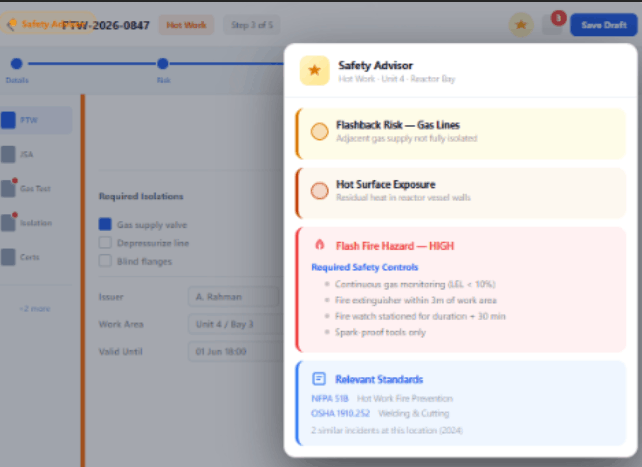
Lastly, we have leveraged RAG to extract information relevant to a particular task – such as the scaffolding height for a work-at-height job. The input to the RAG is the corpora of documents, such as reports on incidents and near misses, and permits. This can be augmented with external information. A weather API could recommend against a work at height job on a particular day at a particular time due to the wind speed.
(Refer to Figure 6)
In summary, we believe AI, deployed in a highly targeted manner, to address user problems that are noted only after deep immersion in the user’s environment.
Permit management as a HSE problem is far from solved. For too long the goal was compliance through self-declaration. The letter, not the spirit. It’s time the industry used bleeding edge technology to make things safer.