 English
 Português
 Español
If you run a mobile tower installation or power transmissions operation, safety gets complicated quickly. Particularly if your operations are in a large territory with diverse terrain such as India.
There’d be sites across plains, urban spots, rural parts, jungle, forests, hills, and actual mountains. In addition, the terrain will change over seasons. A barren spot can get waterlogged and/or covered in vegetation during the monsoons.
Also, in the world’s 7th largest country by land area, the number of sites is over 100,000. In a country of 1.4 billion Utilities must reach the furthest corners. And operations necessary to pull that off must be safe.
There’s no practical way to air drop a safety crew everywhere, from an island in the Arabian sea to a village in the Himalayas.
Enter AI.
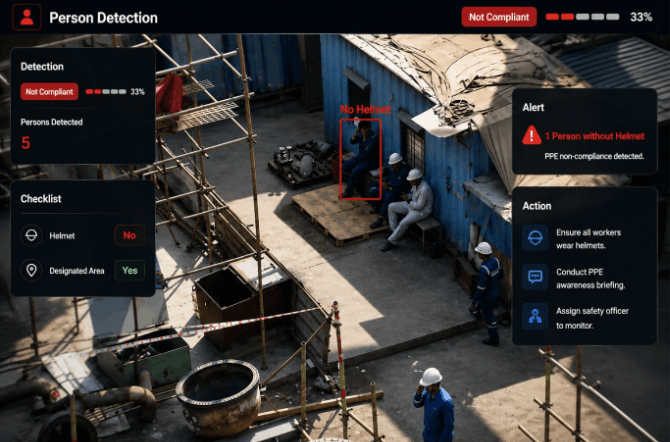
More specifically, a computer vision solution by Maximl – Smartlens.
Recently, Smartlens automated safety checks for one of the top three mobile tower infrastructure companies in the world. The scope was over 250,000 sites.
Smartlens’ algorithms check for compliance across:
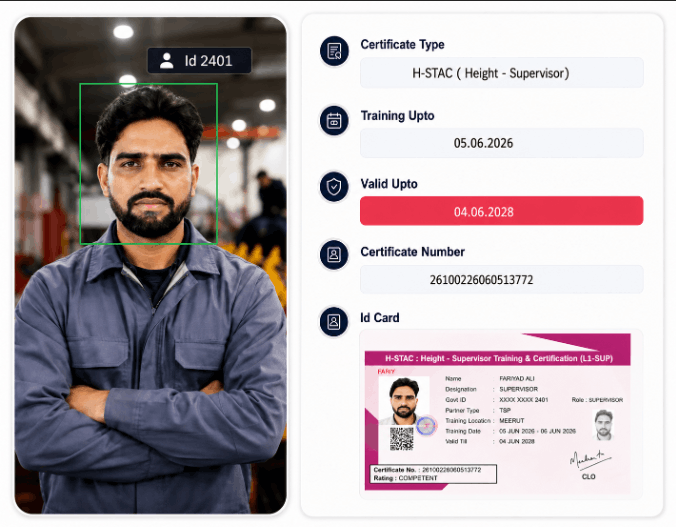
- Identity authentication: does the face match the ID?
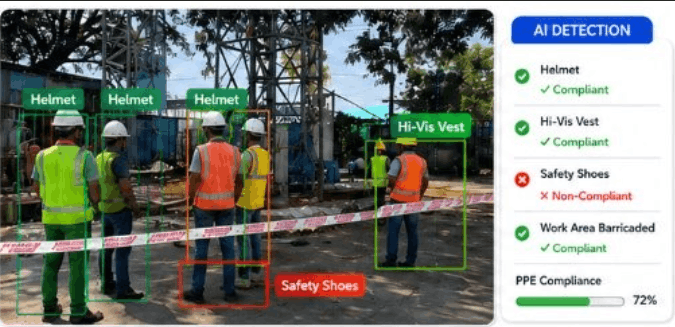
- PPE: the right make and condition of helmets, gloves, and boots.
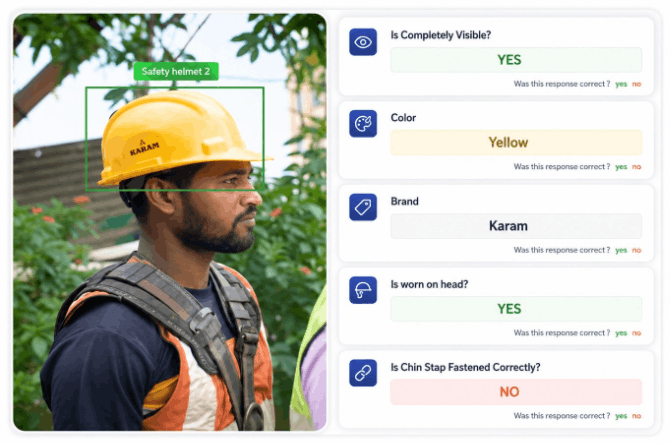
- PPE used right: helmet worn right, full body harness on.
- Safety profile of the site: unacceptably high water logging or too thick vegetation.
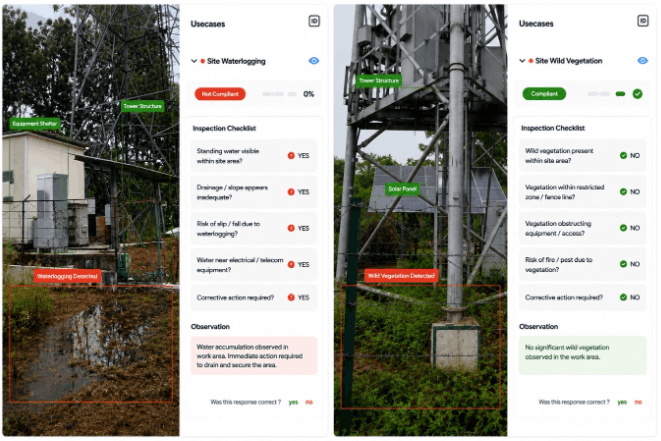
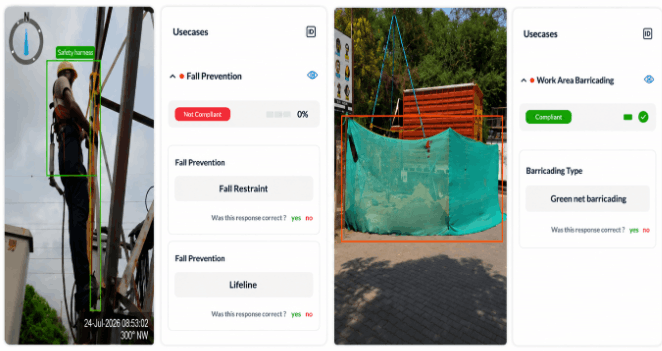
- Adequacy of safety measures: work area barricading, fall prevention.
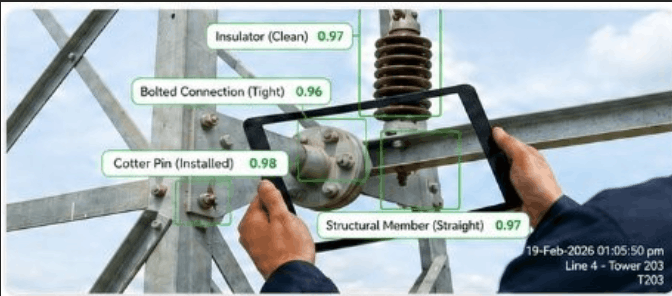
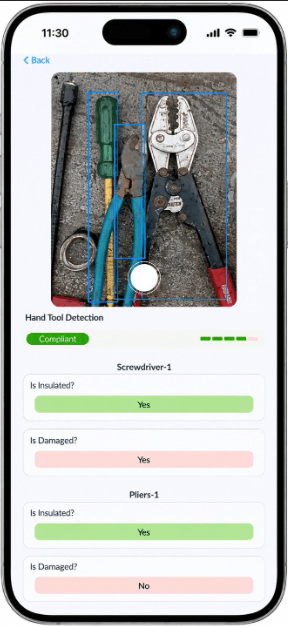
- Electrical Safety: for real-time detection of electrical safety risks across tools, open connections, and improper grounding practices.
In all Smartlens performs 27 checks, operating at an accuracy of 90 percent (a compliant/non-compliant decision at site entry). The accuracy for ID validation is 94%.
Much engineering has gone into making image processing work well within a large enterprise; and in conditions common when sites are many and widely distributed.
The default is a phone camera, not a CCTV camera. An image is processed in between 200 and 500 milliseconds.
To prevent fraud, there are measures against identity spoofing. A contract worker cannot present the digital image of a face. It must be a real face and match the image of the same individual in the database. This check (i.e. there’s a real object facing the camera and not a digital image) applies not just to the face but every other check the Smartlens algorithm does.
Maximl’s image processing algorithms extract attributes from the image (such as the brand and the colour of a helmet) which can then be used in programmable workflows downstream. Examples of such programmable attributes also include segmentation into zones and components pixel-by-pixel for granular analysis of complex scenes, and visual condition categories such as
‘clean/unclean’, ‘damaged/intact’.
The vision AI solution is integrated with the permit process at the telecom infrastructure company. There is a compliant/non-compliant decision at the site entry point. Can a person or crew be allowed? Is the site itself safe for work on that day?
Similar use cases can be addressed in any industrial or logistics site where manual compliance checks are uneconomical.
An advanced version of Smartlens goes beyond compliance, into automating proof of work as part of asset maintenance:
- Spares Validation: validating spare part replacements against work orders to guarantee preventive maintenance compliance.
- Equipment Condition: for visual condition checks to identify early signs of asset health deterioration and housekeeping issues.
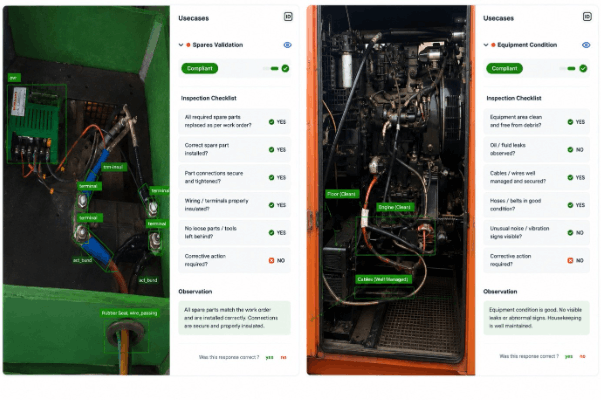
The proof-of-work checks are integrated with the permit process for diesel generator condition monitoring and spare part checks.
Across all use cases at this ‘global top three’ mobile tower infrastructure company, the scale is best-in-class with over 65000 images processed daily and 800 permits processed per hour. The TAT for the manual processes was 30 minutes, Post automation by Smartlens, it is now under 5 minutes.
But Smartlens goes beyond operational efficiency. Vision AI-based automated safety checks allow business to grow without safety slowing it down.